
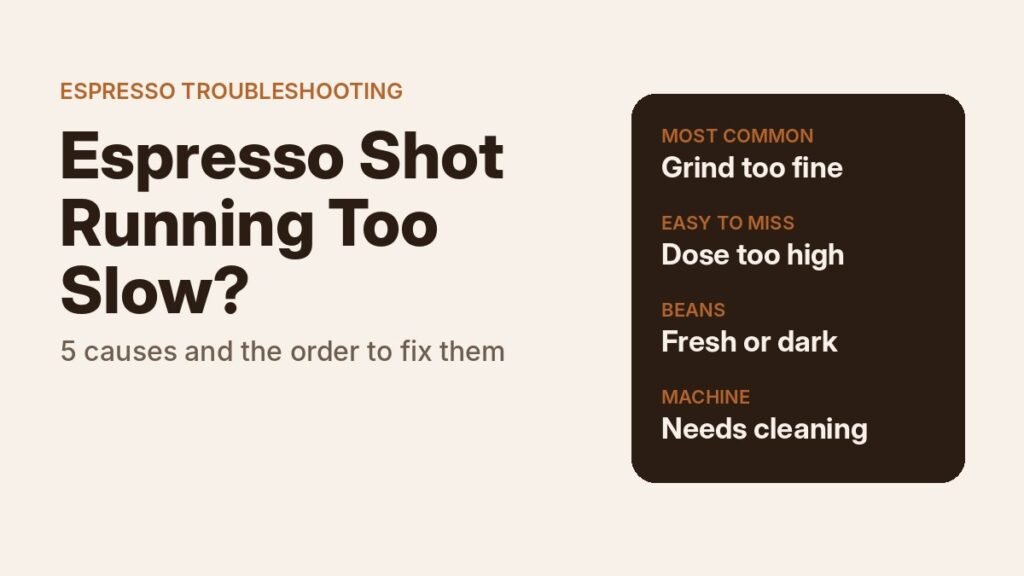
If your espresso shot is running too slow, dripping out over 40 seconds or more and tasting bitter, harsh or dry, the water is meeting too much resistance in the puck. The usual fix is a coarser grind. But if the real problem is too much coffee in the basket, very fresh beans or a dirty machine, grinding coarser only gets you part of the way.
Below are the five usual causes, how to spot each one, and the order to try the fixes. It’s the companion to our guide on espresso shots running too fast. We haven’t tested machines or grinders ourselves for this guide. It’s built from roaster, retailer and manufacturer guides (listed at the end), and we point out where they disagree.
Quick answer: how to speed up a slow espresso shot
- 1. Grind coarser, one small step at a time, and pull another shot.
- 2. Weigh your dose. An overfilled basket runs slow.
- 3. Use a starting target of about 18g in, 36g out in 25 to 35 seconds.
- 4. Tamp level and consistently. Pressing harder rarely helps.
- 5. Still slow? Re-dial for fresh or darker beans, and clean or descale the machine.
Change one thing at a time and taste after each shot.
Table of contents
How slow is too slow?
Most guides start from a 1:2 ratio, such as 18g of coffee in and 36g of espresso out. Clive Coffee and Whole Latte Love both aim for 25 to 30 seconds, while Coffee Bros uses 30 to 36 seconds. Clive Coffee describes a shot over 35 seconds that comes out dark, bitter and dripping as the classic slow shot.
Treat those numbers as a starting point. A slow shot is a problem because of how it tastes: over-extracted espresso is usually bitter, harsh and dry. If that’s what you’re getting, our guide to why espresso tastes bitter goes deeper on the flavour side. Weigh the shot and time it the same way every time, or you can’t tell whether a change helped. Our guide on how to use an espresso scale walks through the routine.
Why is my espresso shot running too slow? 5 causes
1. Your grind is too fine
This is the most common cause. Clive Coffee puts it bluntly: a slow, bitter, dripping shot over 35 seconds means the grind is too fine, and the water is choking on a puck that’s too dense. Breville’s troubleshooting advice says the same: slow flow usually means the grind is too fine or the dose is too high.
Go one step coarser, pull another shot with the same dose, and repeat until you’re in your target range. Whole Latte Love suggests a small adjustment if the shot is only a few seconds slow, and a few notches if it’s well over. Clive Coffee’s advice is to change only the grind, one step at a time, until you hit the window.
Two grinder problems can look like a fine grind. Coffee Bros notes that burrs shift with use, so a setting that used to work can drift; recalibrating fixes it. And Clive Coffee points out that inconsistent grinders produce a mix of fine dust and larger pieces, which makes shots hard to control at any setting. If your grinder can’t make small, repeatable changes, our best coffee grinders under $200 guide covers espresso-capable upgrades.
2. There’s too much coffee in the basket
An overfilled basket makes a thicker puck that’s harder for water to push through. Coffee Bros recommends staying within your basket’s rated range, give or take 2g, and Breville suggests using slightly less coffee if shots run slow.
There’s a sneaky version of this too. If your grinder doses by time, Coffee Bros points out that a finer setting puts more coffee into the basket in the same number of seconds. So grinding finer can quietly raise your dose as well. Weigh every dose, whatever your grinder says. Our guide to espresso brew ratios explains how dose and yield work together.
Weigh every shot
Timemore Black Mirror Basic 2.0
You can’t see a two-gram difference in the basket by eye, and that’s enough to slow a shot down. A scale with a timer shows your dose, your yield and your shot time together, so you know whether the fix is less coffee or a coarser grind. This one reads to 0.1g and has a built-in timer, according to Timemore.
Key details (manufacturer and retailer figures)
- 0.1g precision, up to 2kg
- Timer with an auto-start mode
- About 6 x 5.1 x 1 inches
- USB-C rechargeable, rated for about 10 hours per charge
What’s good
- Precise and quick to respond, per Home Grounds
- Works for espresso and pour-over
- No batteries to replace
Watch out for
- Touch buttons are easy to press by accident
- Water-resistant, not waterproof
- Check the drip tray first: it is not the smallest scale
Free espresso gear updates
Get the next buying guide in your inbox
We’ll email you when a new guide or comparison goes live, so you can compare gear before you buy. No spam, and you can unsubscribe anytime.
3. You’re tamping too hard, or unevenly
The sources disagree here. Whole Latte Love lists tamping too hard as a possible cause of slow shots and suggests about 40 lb of pressure. Clive Coffee argues that once the puck is level and gap-free, more pressure does almost nothing: tamping seats the puck, while grind size regulates the flow.
Our read: if you’ve been leaning on the tamper with all your weight, ease off to a firm, level press, then use the grinder to fix the speed. Consistency matters more than force. A spring-loaded or calibrated tamper takes the guesswork out; see our guide to the best tamper for Breville 54mm portafilters.
4. Your beans are very fresh, or roasted darker than before
Coffee Bros notes that fresh coffee generally needs a coarser grind than older coffee, and darker roasts need a coarser grind than lighter ones. So if you’ve just opened a bag roasted a few days ago, or switched from a light roast to a dark one, the setting that worked yesterday can suddenly run slow.
The fix is to re-dial with each new bag: start a step or two coarser than your old setting and adjust from there. It works the other way too. As a bag ages over a few weeks, you’ll usually need to go finer again, which is one reason shots can drift fast. Our too-fast guide covers that side.
5. Your machine needs cleaning or descaling
If a shot that used to run fine has slowed down without any change in grind or dose, look at the machine. Coffee Bros says coffee residue on the shower screen affects flow and recommends wiping the group head every few brews and cleaning the basket properly, not just rinsing it. Breville says weak or no flow can mean the machine needs descaling, which can clear blockages, and suggests running a backflush cycle where your machine supports one.
Also check the obvious: Breville’s troubleshooting page reminds owners to make sure the water tank is filled and seated properly before blaming the coffee.
The order to try fixes in
- Measure first. Weigh your dose and your yield, and time the shot the same way every time.
- Check the dose. Stay within your basket’s rated range, and weigh rather than trusting a timed grind.
- Grind coarser in small steps until the shot lands in your target range.
- Ease off the tamp. A level, consistent press is enough.
- Re-dial for your beans. Very fresh or darker roasts usually need a coarser setting.
- Clean the machine. Wipe the shower screen, clean the basket, and descale on schedule.
Change one thing at a time and taste after each shot. If you change the dose and the grind together, you won’t know which one fixed it.
When a slow shot is fine
Time is a guide, and taste is the final check. If a shot runs a few seconds over your target but tastes sweet and balanced, keep it. The ranges above are where most people should start, not a pass or fail line.
Related guides
- Espresso shot running too fast? 7 causes and fixes
- Why does my espresso taste bitter?
- Why does my espresso taste sour?
- Espresso brew ratios explained
- Best espresso scale
- Best coffee grinders under $200
Frequently asked questions
Why is my espresso shot taking 40 seconds or more?
Usually the grind is too fine, the dose is too high, or both. Weigh your dose first, then grind a step or two coarser. If the shot slowed down suddenly with no change to your recipe, clean the shower screen and basket, and check whether the machine is due for descaling.
Should I tamp lighter if my espresso runs slow?
Sources disagree. Whole Latte Love lists tamping too hard as a cause, while Clive Coffee argues that once the puck is level, extra pressure makes little difference. Tamp firmly and evenly, and use the grinder to change the speed.
Does grinding coarser speed up espresso?
Yes. Coarser grounds give the water an easier path, so the shot runs faster. Change it in small steps so you don’t overshoot into a fast, sour shot.
Can fresh coffee beans make espresso run slow?
They can. Coffee Bros notes that fresh coffee generally needs a coarser grind than older coffee, so a just-opened bag may run slow at your usual setting. Re-dial with each new bag.
How long should an espresso shot take?
Most guides use about 25 to 35 seconds for a double with a 1:2 ratio, such as 18g in and 36g out. Treat that as a starting point and adjust by taste.
Sources
- Clive Coffee, Espresso troubleshooting guide: fix bad shots
- Breville, Espresso machine problems and fixes
- Coffee Bros, Top 10 reasons your espresso shot pulls too slow or too fast
- Whole Latte Love, Barista cheat sheet
- Timemore product information (specs as listed by the manufacturer)