
Flat vs conical burrs is the grinder question that starts more forum arguments than almost any other. The honest answer is less dramatic than the arguments suggest. Burr shape does change the texture and clarity of your espresso, but at home, burr size, alignment and how finely a grinder adjusts usually matter more than shape alone. Want an electric grinder, or one for drip and pour-over too? See our best coffee grinders under $200.
This guide explains what each burr type does, what you are likely to notice in the cup, and which grinders on Amazon right now fall on each side. We compared them using manufacturer specifications, published grinder guides and patterns in owner feedback. We haven’t tested these grinders ourselves, and we point out where a detail comes from a manufacturer or seller.
Quick answer: flat or conical burrs for espresso?
- Choose conical if you mostly make milk drinks or use medium to dark roasts and want a full-bodied, forgiving shot.
- Choose flat if you drink lighter roasts as straight espresso and want more clarity and separation between flavors.
- Under about $250, conical is the practical choice. Most espresso-capable grinders at that price use conical burrs.
- Already own a capable conical grinder? Upgrade to flat only if you want a different flavor style, not because flat burrs are simply better.
Prices change often, so check the current price on Amazon before you buy.
Table of contents
What is the difference between flat and conical burrs?
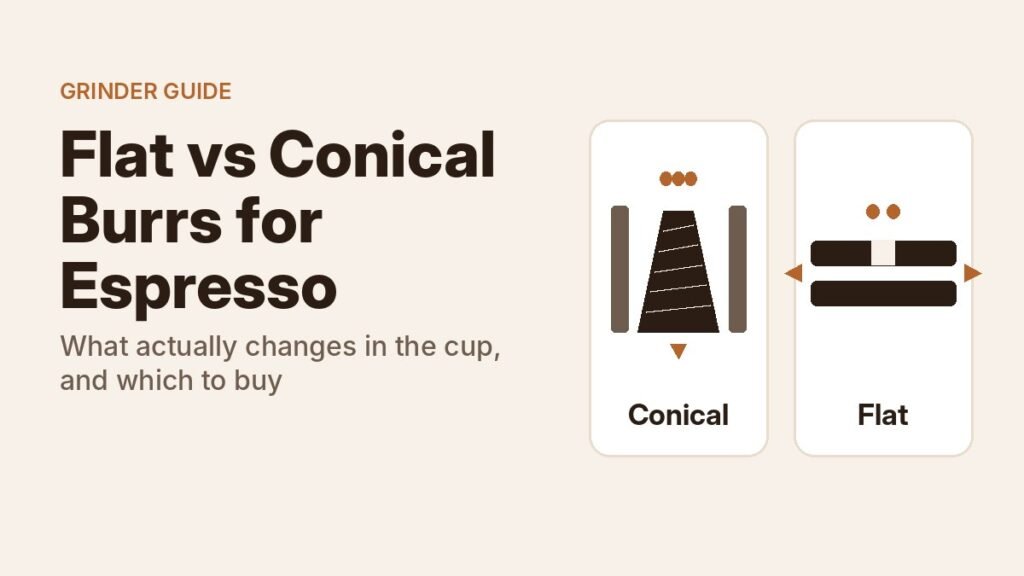
A conical burr set is a cone-shaped inner burr turning inside a ring-shaped outer burr. Beans drop in from the top and are crushed finer and finer as they work down the narrowing gap, with gravity helping them through. A flat burr set is two parallel rings facing each other. Beans enter at the center, get pushed outward between the burr faces and leave from the sides.
That difference in path leads to the two things people actually argue about: the spread of particle sizes, and speed, heat and noise.
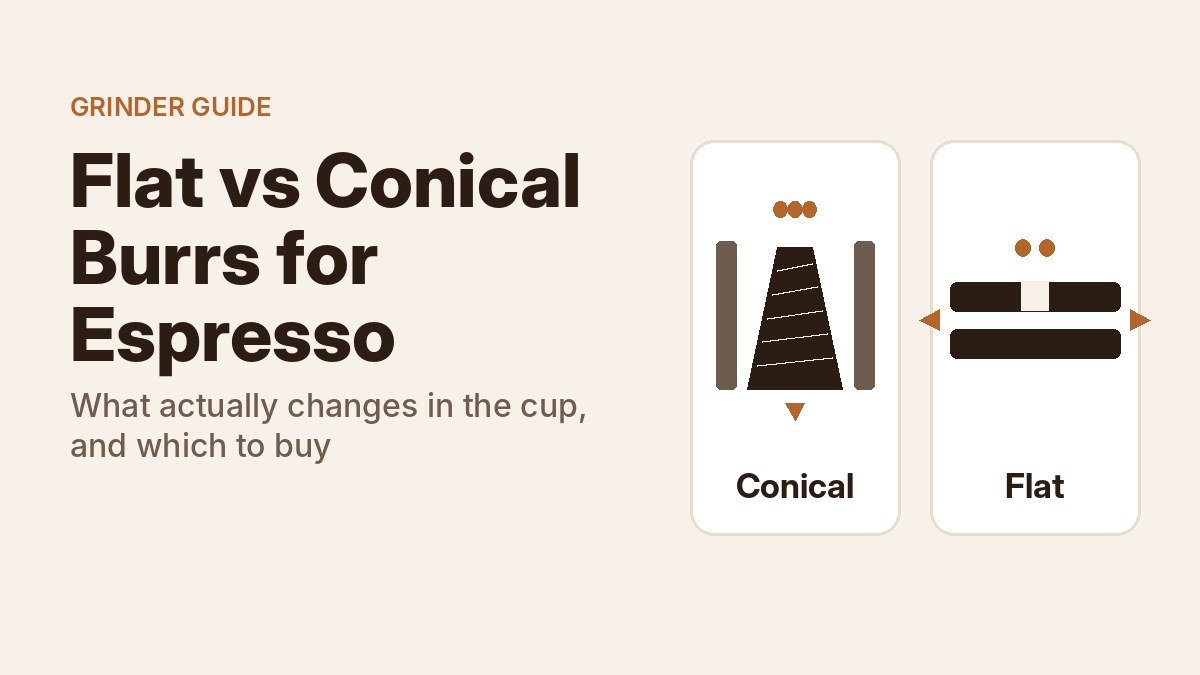
How burr shape changes your espresso
Particle size: one peak or two
No grinder produces one particle size. You always get a range. Flat burrs tend to cluster most particles around a single size, often described as unimodal. Conical burrs tend to produce two clusters: the main grind size plus a larger share of very small particles called fines, described as bimodal. Clive Coffee published particle-size measurements from a flat-burr and a conical-burr grinder that show exactly this pattern, with one peak for the flat burr and two for the conical.
What that means for taste
Fines extract quickly and slow the flow of water through the puck. In espresso that tends to add body and a heavier, syrupy texture, with flavors that blend together. Fewer fines tend to give a cleaner, brighter shot where individual flavor notes are easier to pick out, with a little less body.
Neither style is correct. Espresso Vivace co-founder David Schomer has said he prefers conical burrs precisely because their fines add body to the shot, as Home Grounds reports, while many specialty cafés pulling light-roast espresso favor flat burrs for clarity. Our assessment: if most of your coffee has milk in it, the extra body from conical burrs is an advantage, not a compromise.
Forgiveness while dialing in
Retailers and owners often describe conical burrs as more forgiving, meaning shots taste acceptable across a slightly wider range of settings. Flat burrs tend to reward precise dialing in and can be less tolerant of a setting that is slightly off. Treat this as a widely reported tendency rather than a measured rule. If your shots are going wrong, our guide to why espresso tastes bitter covers the usual causes before you blame the burrs.
Speed, heat, noise and retention
Flat-burr grinders usually spin faster, while conical grinders usually spin slower, which is why conicals tend to be quieter and generate less heat. For a sense of scale, Baratza lists the conical Encore ESP at 550 RPM, and Eureka lists the flat-burr Mignon Specialita at 1,350 RPM.
At home, heat rarely matters. Seattle Coffee Gear makes the same point in its burr guide: grinding one or two doses at a time doesn’t warm the burrs enough to worry about. Heat is a bigger concern in busy cafés grinding all day.
Retention, the coffee left inside the grinder after each dose, depends far more on the grinder’s design than on burr shape. Coffee Chronicler notes that two conical grinders can sit at opposite extremes, with the Niche Zero retaining very little and other conical models retaining a lot. Modern single-dose flat-burr grinders such as the DF54 and DF64 Gen 2 are built specifically to keep retention low.
Flat vs conical burrs at a glance
| Factor | Conical burrs | Flat burrs |
|---|---|---|
| Particle spread | Two peaks, more fines | One tighter peak, fewer fines |
| Espresso taste (tendency) | More body, rounder, blended | More clarity, brighter, more separation |
| Best with | Milk drinks, medium and dark roasts | Straight espresso, light roasts |
| Dialing in | Usually more forgiving | Rewards precision |
| Speed and noise | Slower, usually quieter | Faster, often louder |
| Typical price tier for espresso | Budget to mid-range | Mid-range to premium |
Tendencies drawn from manufacturer guides, retailer guides and published particle-size data. Individual grinders vary.
Conical burr grinders worth considering
Best conical hand grinder
1Zpresso J-Ultra
If you want conical burrs and the finest adjustment for the money, a hand grinder is the way to get it. 1Zpresso says the J-Ultra’s 8-micron steps are the finest in its range. Nearly every espresso hand grinder uses conical burrs, so if you specifically want flat burrs, you will be shopping for an electric grinder.
Key specs (manufacturer and seller figures)
- 48mm conical burrs
- 8 microns per click
- 35–40g capacity, magnetic catch cup
- Foldable handle
What’s good
- Very fine adjustment makes dialing in easier
- Costs less than any flat-burr electric grinder we found
- No motor, so it is quiet
Watch out for
- Expect 30 to 60 seconds of grinding per dose
- Tiring if you make several drinks in a row
- One of the pricier hand grinders
Best conical electric under $200
Baratza Encore ESP
The Encore ESP is the cheapest electric grinder we would consider for espresso. Baratza splits its 40 settings into fine micro-steps for espresso (settings 1 to 20) and larger steps for filter coffee (21 to 40), so you get resolution where espresso needs it.
Key specs (manufacturer and seller figures)
- 40mm M2 conical steel burrs
- 550 RPM motor, per Baratza
- Dosing cup fits 54mm portafilters, with a 58mm adapter
- Quick-release burr for easier cleaning
What’s good
- Fine steps exactly where espresso needs them
- Dosing cup suits Breville 54mm machines
- Baratza is known for parts and repair support
Watch out for
- Not a zero-retention grinder, as reviewers note
- Light roasts take patience to dial in, per Barista Life
- Less adjustment resolution than the J-Ultra
Free espresso gear updates
Get the next buying guide in your inbox
We’ll email you when a new guide or comparison goes live, so you can compare gear before you buy. No spam, and you can unsubscribe anytime.
Own a Breville Barista Express or Barista Pro? Breville describes their built-in grinders as conical burr grinders, so you already know the conical style. Our Barista Express vs Barista Pro comparison covers how those two grinders differ, and if you own a Bambino, see our best grinder for the Breville Bambino.
Flat burr grinders worth considering
Cheapest flat burr on Amazon
DF54
The DF54 was the most affordable flat-burr grinder we found on Amazon when we checked. It is a single-dose grinder: you weigh the beans for each shot and grind them all, rather than keeping a hopper full.
Key specs (manufacturer and seller figures)
- 54mm stainless steel flat burrs
- Stepless adjustment
- Plasma ionizer to reduce static, per the seller
- 58mm dosing cup included
What’s good
- Flat burrs for little more than a premium conical grinder
- Seller claims almost zero retention
- Stepless dial means no gaps between settings
Watch out for
- Single dose only, with no hopper or timer
- 58mm dosing cup, so check the fit with a 54mm portafilter
- Shorter track record than established brands like Baratza or Eureka
Best flat burr upgrade
DF64 Gen 2
The DF64 Gen 2 steps up to larger 64mm flat burrs, and it accepts aftermarket SSP burrs if you want to change its flavor profile later. It is the pick if you are sure you want flat burrs and plan to keep the grinder for years.
Key specs (manufacturer and seller figures)
- 64mm flat burrs
- Stepless adjustment, plasma generator to reduce static
- Seller lists retention under 0.1g
- Holds 20g without the bellows, 50g with it
What’s good
- Large flat burrs for the price
- Burr upgrade path as your taste develops
- Reviewers praise its low retention and static control
Watch out for
- Single-dose workflow, weigh every dose
- Heavier and taller than the DF54
- Sold under several names (DF64, Turin, MiiCoffee), which can confuse shopping
Best flat burr with a hopper
Eureka Mignon Specialita
If you drink the same beans every day and don’t want to weigh each dose, the Specialita is a traditional hopper grinder with timed dosing. Eureka pairs 55mm hardened steel flat burrs with a sound-insulated case, and owners often mention how quiet it is for a flat-burr grinder.
Key specs (manufacturer and seller figures)
- 55mm hardened steel flat burrs
- 1,350 RPM, stepless adjustment
- Touchscreen with single, double and continuous modes
- 300g bean hopper
What’s good
- Grind-by-time makes repeat doses quick
- Insulated case for a flat-burr grinder
- Long-established Italian maker
Watch out for
- Most expensive pick here
- Hopper design suits one coffee, not frequent bean swaps
- Timed doses still drift, so weigh them occasionally
Which should you buy?
The flat vs conical burrs decision comes down to what you drink more than which technology is superior. Start from your drinks and budget:
- You mostly make lattes and flat whites: conical. The Encore ESP or the J-Ultra.
- You drink light-roast espresso straight: flat. The DF54 to start, the DF64 Gen 2 to stay.
- Your budget is under $200: conical, because espresso-capable flat burrs start higher.
- You want a hopper and timed dosing: the Eureka Mignon Specialita.
Whichever burr type you choose, weighing your dose and yield matters as much as the burrs. Our guide on how to use an espresso scale explains the routine, and a WDT tool helps break up clumps from any grinder.
Related guides
- Best coffee grinder under $200 for espresso
- Best grinder for the Breville Bambino
- Best WDT tool for espresso
- Why does my espresso taste bitter?
- Espresso brew ratios explained
- Breville Barista Express vs Barista Pro
Frequently asked questions
Are flat burrs better than conical burrs for espresso?
Not overall. In the flat vs conical burrs debate, flat burrs tend to give more clarity and conical burrs more body. For milk drinks and darker roasts, many people prefer conical. For light-roast straight espresso, many prefer flat. Burr size, alignment and adjustment matter as much as shape.
Do conical burrs produce more fines?
Generally, yes. Conical burrs tend to produce a second cluster of very fine particles, which adds body and slows the shot. Flat burrs tend to produce a tighter range of sizes with fewer fines.
Is a flat burr grinder worth it for milk drinks?
Usually not as an upgrade on its own. Milk softens the clarity flat burrs are prized for, and the extra body from conical burrs suits milk drinks well. Spend on a grinder with fine, repeatable adjustment first.
Are hand grinders flat or conical?
Almost all espresso hand grinders use conical burrs, including every model in our under-$200 grinder guide. If you want flat burrs, you will be looking at electric grinders.
Does burr size matter more than burr shape?
Often, yes. Larger burrs generally grind faster and with less effort, and a well-aligned grinder with fine adjustment will beat a poorly made one of either shape.
Sources
Specifications were checked against these sources in October 2026. Manufacturer pages are the best place to confirm current details.
- Clive Coffee: What is particle size?
- Honest Coffee Guide: Conical burrs vs flat burrs
- Home Grounds: Flat vs conical burr grinder
- Prima Coffee: Conical vs flat burrs
- Seattle Coffee Gear: Conical vs flat burr grinders
- Coffee Chronicler: Conical vs flat burr grinders
- Barista Life: Baratza Encore ESP review
- Home Coffee Solutions: DF54 specifications