
Why does my espresso taste sour? Sharp, thin, almost lemony shots are one of the most common problems with a new espresso setup. The good news: sourness nearly always points to the same thing, under-extraction. The water ran through the coffee too fast, or didn’t get enough flavour out, before the shot ended.
Below are the seven usual causes, how to tell which one you have, and the order to try the fixes. We haven’t tested machines or grinders ourselves for this guide. It’s built from roaster and retailer dial-in guides (listed at the end) and our own reading of where they agree and disagree.
Quick answer: how to fix sour espresso
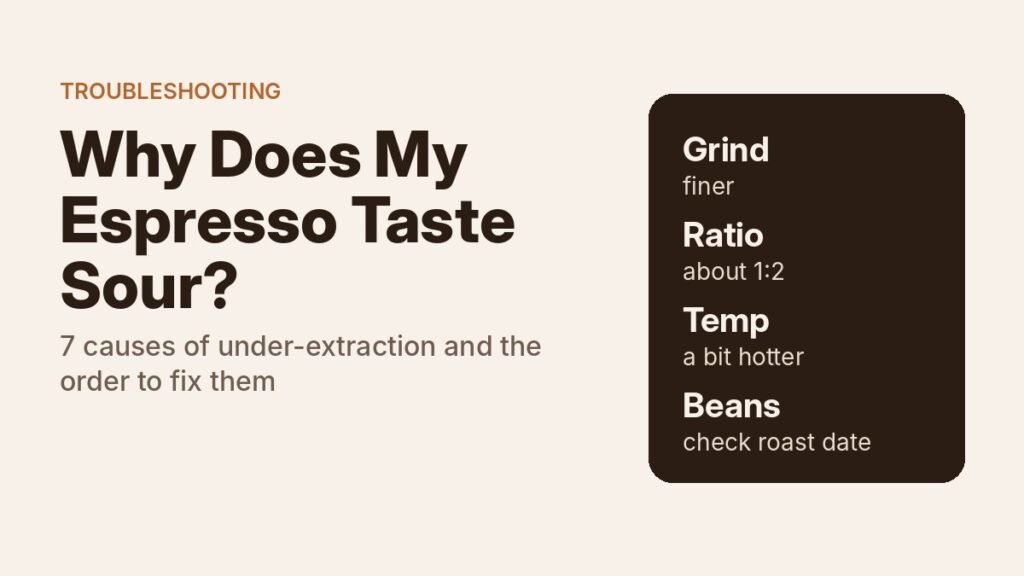
- 1. Grind finer so the shot runs slower.
- 2. Let the shot run longer: aim for about a 1:2 ratio (for example 18g in, 36g out).
- 3. Weigh your dose and yield on a scale instead of guessing.
- 4. Check your beans: very fresh or very old coffee can both taste sour.
- 5. If it’s still sour, raise the brew temperature a little and check the machine for scale.
Change one thing at a time and taste after each shot.
Table of contents
First, is it sour or bitter?
It’s easy to mix the two up, and they need opposite fixes. If you’re not sure, the speed of the shot is the best clue.
| Sour (under-extracted) | Bitter (over-extracted) | |
|---|---|---|
| Tastes | Sharp, thin, salty or lemony, short finish | Harsh, dry, ashy, lingering |
| Shot speed | Usually fast, often under 20 seconds | Usually slow, often over 35 seconds |
| Typical cause | Grind too coarse, shot too short | Grind too fine, shot too long |
| First fix | Grind finer | Grind coarser |
Shot tastes harsh and dry instead? See why does my espresso taste bitter for the opposite set of fixes.
Why does espresso taste sour? 7 causes and fixes
1. Your grind is too coarse
This is the most common cause by a wide margin. Coarse grounds let water rush through, so it doesn’t pick up the sweeter, heavier flavours that come later in extraction. Seattle Coffee Gear notes that if your shots consistently run in under 20 seconds, grind size is the likely culprit.
Fix: go one step finer and pull another shot with the same dose and yield. Keep going until the shot takes roughly 25 to 30 seconds. If your grinder can’t go fine enough for espresso (common with drip grinders), no amount of dialling in will help. Our guide to hand grinders for espresso under $200 covers budget grinders that can, and our best coffee grinders under $200 guide adds electric options.
2. The shot is too short
Even with the right grind, stopping the shot too early leaves it under-extracted. A common starting point is a 1:2 ratio: 18g of coffee in, about 36g of espresso out. Clive Coffee suggests that if you’re only getting around 20g out of an 18g dose, you’re likely under-extracting.
Fix: let the shot run to about twice the dose by weight. Kaffeemacher, a Swiss roaster, suggests 1:2 to 1:2.5, and up to 1:3 for very acidic coffees. More on this in espresso brew ratios explained.
3. You’re guessing your dose and yield
If you go by eye or by the volume in the cup, you can’t tell whether a sour shot was too short, too fast or under-dosed. Crema makes volume especially misleading. A scale turns guesswork into two numbers you can actually adjust. If you don’t have one yet, our best espresso scale guide compares six options.
Fix: weigh the ground coffee and the espresso in the cup, and time the shot. See how to use an espresso scale. If you’re on a Breville with a short drip tray, our low-profile espresso scales guide covers which ones fit.
Weigh every shot
Timemore Black Mirror Basic 2.0
Most sour shots are short shots, and you can’t see that by eye. A scale with a timer shows exactly how much espresso came out and how long it took, so you know whether to grind finer or let the shot run longer. This one reads to 0.1g and has a built-in timer, according to Timemore.
Key details (manufacturer and retailer figures)
- 0.1g precision, up to 2kg
- Timer with an auto-start mode
- About 6 x 5.1 x 1 inches
- USB-C rechargeable, rated for about 10 hours per charge
What’s good
- Precise and quick to respond, per Home Grounds
- Works for espresso and pour-over
- No batteries to replace
Watch out for
- Touch buttons are easy to press by accident
- Water-resistant, not waterproof
- Check the drip tray first: it is not the smallest scale
Free espresso gear updates
Get the next buying guide in your inbox
We’ll email you when a new guide or comparison goes live, so you can compare gear before you buy. No spam, and you can unsubscribe anytime.
4. The water isn’t hot enough
Cooler water extracts less, and acidity takes over. Seattle Coffee Gear gives 195 to 205°F as the usual range and notes that entry-level machines often run slightly cool. Kaffeemacher suggests around 93°C (about 199°F).
Fix: let the machine fully warm up, and run a blank shot through the portafilter first so it’s hot. If your machine lets you adjust temperature, Clive Coffee suggests raising it 1 to 2°F at a time, but only once grind and ratio are sorted.
5. The beans are too fresh, or too old
Very fresh beans still release a lot of CO2, which can disrupt extraction and add sourness. At the other end, Clive Coffee says beans more than three to four weeks past roast can taste flat and sour however well you dial in. Sources don’t agree on the exact window. Kaffeemacher, for example, suggests espresso beans are ready from about two to three weeks after roasting and best for up to around two months.
Fix: check the roast date on the bag. If it was roasted in the last few days, give it a few more days. If it’s well past a month, try a fresher bag before changing anything else. Very light roasts are also naturally brighter, which brings us to the last point below.
6. Water is channeling through the puck
If the coffee in the basket is clumpy or tamped unevenly, water finds the easiest path through it. Part of the puck gets over-extracted and the rest barely touched, and the result can taste sour and bitter at the same time.
Fix: break up clumps with a WDT tool, distribute evenly and tamp level. Our best WDT tool guide compares the options.
Cheapest fix for channeling
Normcore WDT Tool V2.1
A WDT tool stirs the grounds with thin needles to break up clumps before you tamp, so water flows more evenly.
Key specs (manufacturer figures)
- 8 needles, 0.23mm, magnetic stand included
What’s good
- Inexpensive and quick to use
- Works with any machine and basket
- Helps with both bitterness and sourness caused by channeling
Watch out for
- Adds a step to your routine
- Use with a dosing funnel to avoid mess
- Won’t fix a grind that’s simply too fine
7. Mineral scale has built up inside the machine
If your espresso has slowly got more sour over months, mineral build-up can be the reason. Kaffeemacher lists it as a cause of gradually increasing sourness, since scale affects heating and water flow.
Fix: descale the machine following the manufacturer’s instructions, and use filtered or softened water if your area has hard water.
If you own a Breville with a pressure gauge
Machines like the Barista Express and Barista Pro have a pressure gauge with a marked espresso range. A sour shot that gushes out with the needle sitting low is usually the same problem as cause 1 or 3: the grind is too coarse or the dose is too low for the basket. Grind finer first, then check your dose. Our Breville portafilter size guide and Barista Express accessories guide cover the tools that help with dosing and tamping.
The order to try fixes in
- Grind finer until the shot takes about 25 to 30 seconds.
- Weigh dose and yield and aim for about 1:2.
- Check the roast date.
- Improve puck prep: WDT, even distribution, level tamp.
- Raise the temperature slightly, if your machine allows it.
- Descale if sourness has crept in over months.
When a little sourness is fine
Not all acidity is a fault. Light roasts and many African coffees are meant to taste bright and fruity. The difference is balance: pleasant acidity comes with sweetness, while under-extracted sourness tastes thin and sharp with a short finish. Kaffeemacher makes the same point: decide whether the acidity is pleasant before you change your recipe. If you simply prefer less acidity, a medium or darker roast will usually be easier to dial in.
Related guides
- Espresso shot running too fast? 7 causes and fixes
- Why does my espresso taste bitter?
- Espresso brew ratios explained
- Do you need an espresso scale?
- Flat vs conical burrs for espresso
- Best grinder for the Breville Bambino
Frequently asked questions
Does sour espresso mean under-extraction?
Usually, yes. Sourness is the classic sign that water didn’t extract enough from the coffee, most often because the grind is too coarse or the shot was stopped too early.
Should I grind finer or coarser if espresso is sour?
Finer. A finer grind slows the shot and extracts more. Adjust one step at a time and keep your dose and yield the same so you can taste the difference.
Why is my espresso both sour and bitter?
That mix often points to channeling: some of the coffee is over-extracted and some under-extracted in the same shot. Improve your puck prep with WDT and a level tamp before changing the grind.
How long should a shot take to avoid sourness?
Around 25 to 30 seconds for a 1:2 ratio is a common target (Clive Coffee). Kaffeemacher suggests about 22 to 28 seconds, or 25 to 30 with pre-infusion. Use these as starting points and let taste decide.
Sources
- Clive Coffee, Why is my espresso sour or bitter? How to fix it
- Seattle Coffee Gear, Why does my espresso taste sour or bitter?
- Kaffeemacher, sour espresso guide (Espresso sauer)
- Timemore product information for the Black Mirror Basic 2.0 (specs as listed by the manufacturer)