
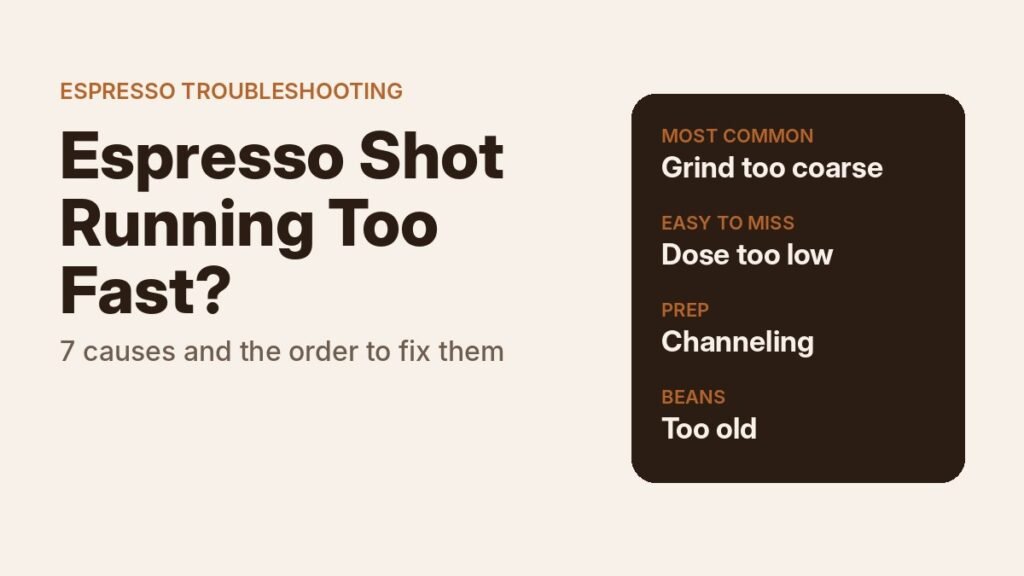
If your espresso shot is running too fast, gushing into the cup in 10 or 15 seconds and tasting thin or sour, the water isn’t meeting enough resistance in the puck. The usual fix is a finer grind. But grinding finer won’t help if the real problem is your dose, your beans or your basket, and that’s where most people get stuck.
Below are the seven usual causes, how to spot each one, and the order to try the fixes. We haven’t tested machines or grinders ourselves for this guide. It’s built from roaster, retailer and manufacturer guides (listed at the end), and we point out where they disagree.
Quick answer: how to slow down a fast espresso shot
- 1. Grind finer, one small step at a time, and pull another shot.
- 2. Weigh your dose. An underfilled basket runs fast.
- 3. Use a starting target of about 18g in, 36g out in 25 to 35 seconds.
- 4. Break up clumps and tamp level to stop channeling.
- 5. Still fast? Check the roast date, your basket type and the machine for scale.
Change one thing at a time and taste after each shot.
Table of contents
How fast is too fast?
Most guides start from a 1:2 ratio, such as 18g of coffee in and 36g of espresso out. They differ a little on time: Whole Latte Love’s cheat sheet aims for 25 to 30 seconds, Clive Coffee suggests 25 to 35 seconds for a double, and Coffee Bros uses 30 to 36 seconds. Clive Coffee describes a shot under 20 seconds that tastes thin, watery and sour as the classic fast shot.
Treat those numbers as a starting point, not a rule. A fast shot is a problem because of how it tastes: under-extracted espresso is usually sour and thin. If that’s what you’re getting, our guide to why espresso tastes sour goes deeper on the flavour side.
You also need to measure the shot to know it’s fast. Crema makes the volume in the cup misleading, so weigh the espresso and time it. Our guide on how to use an espresso scale walks through the routine.
Why is my espresso shot running too fast? 7 causes
1. Your grind is too coarse
This is the most common cause, and every source we checked puts it first. Breville’s own troubleshooting advice is simple: if shots are coming out too fast, try a finer grind setting. Coarser grounds leave bigger gaps for water to rush through.
Go one step finer, pull another shot with the same dose, and repeat until you’re in your target range. Clive Coffee estimates that one grinder click can change shot time by around five seconds, so small steps are enough. Avoid big jumps: grind too fine and you can choke the machine. Write down your setting and shot time each time so you can see the pattern.
If you’re at your grinder’s finest setting and the shot still runs fast, the grinder probably can’t grind fine enough for espresso. That’s common with blade grinders and burr grinders built mainly for drip coffee. Our best coffee grinders under $200 guide covers espresso-capable picks, including the Baratza Encore ESP (paid link), which Baratza designed for espresso as well as filter. If you’d rather go manual, see our best hand grinders for espresso under $200.
2. You’re using too little coffee
An underfilled basket leaves extra space above the puck and less coffee for the water to push through, so the shot speeds up. Clive Coffee’s example is 14g of coffee in an 18g basket. If you’re scooping by eye or using the scoop that came with your machine, this is easy to miss.
Weigh every dose and stay within your basket’s rated range. Clive Coffee notes most double baskets take 16 to 20g, with 18g as a common starting point. For the Breville Bambino’s 2-cup single-wall basket, Seattle Coffee Gear lists 16 to 19g. Our guide to espresso brew ratios explains how dose and yield work together.
Weigh every shot
Timemore Black Mirror Basic 2.0
You can’t judge a fast shot by eye, because crema makes the volume in the cup misleading. A scale with a timer shows your dose, your yield and your shot time together, so you know whether the fix is more coffee or a finer grind. This one reads to 0.1g and has a built-in timer, according to Timemore.
Key details (manufacturer and retailer figures)
- 0.1g precision, up to 2kg
- Timer with an auto-start mode
- About 6 x 5.1 x 1 inches
- USB-C rechargeable, rated for about 10 hours per charge
What’s good
- Precise and quick to respond, per Home Grounds
- Works for espresso and pour-over
- No batteries to replace
Watch out for
- Touch buttons are easy to press by accident
- Water-resistant, not waterproof
- Check the drip tray first: it is not the smallest scale
Free espresso gear updates
Get the next buying guide in your inbox
We’ll email you when a new guide or comparison goes live, so you can compare gear before you buy. No spam, and you can unsubscribe anytime.
3. Water is channeling through the puck
Channeling happens when water finds weak spots in the puck and rushes through them instead of passing evenly through all the coffee. Breville describes it as “multiple thin streams” coming from the portafilter. A channeled shot can run fast and taste sour and bitter at the same time, because some coffee is over-extracted while the rest barely gets touched.
The fixes are about prep. Break up clumps before you tamp, level the grounds, and tamp straight down. Breville also advises against tapping the portafilter after tamping, which can crack the puck. A WDT tool is the cheapest way to break up clumps, and a dosing funnel keeps the mess down while you stir. Our best WDT tool guide compares options.
Cheapest fix for channeling
Normcore WDT Tool V2.1
A WDT tool stirs the grounds with thin needles to break up clumps before you tamp, so water flows more evenly.
Key specs (manufacturer figures)
- 8 needles, 0.23mm, magnetic stand included
What’s good
- Inexpensive and quick to use
- Works with any machine and basket
- Helps with both bitterness and sourness caused by channeling
Watch out for
- Adds a step to your routine
- Use with a dosing funnel to avoid mess
- Won’t fix a grind that’s simply too coarse
4. Your tamp is uneven
Here the sources disagree, so it’s worth being clear. Whole Latte Love suggests tamping harder, around 40 lb, for a fast shot. Coffee Bros recommends an even 30 lb. Clive Coffee argues that tamp pressure barely changes shot speed: by its estimate, going from 20 to 40 lb might save about one second, while one grind click changes time by about five.
Our read: tamp level and the same way every time, and use the grinder to change speed. A tilted tamp leaves one side of the puck thinner, which invites channeling. If you struggle to tamp level, a spring-loaded or calibrated tamper helps. See our guide to the best tamper for Breville 54mm portafilters.
5. Your beans are old, or roasted lighter than before
Freshly roasted coffee releases carbon dioxide, and that gas adds resistance in the puck. Clive Coffee says beans more than three to four weeks past roast produce less CO₂, so shots run faster. It suggests a window of about 7 to 21 days after roasting. Very fresh beans, under four or five days, can cause the opposite problem: so much gas that the puck channels.
Coffee Bros adds two related points. As coffee ages, it needs a progressively finer grind. And lighter roasts need a finer grind than darker roasts, so a shot can suddenly run fast when you switch to a lighter bag and keep the same setting. Check the roast date, buy amounts you’ll finish in a few weeks, and expect to re-dial with each new bag. Breville also recommends grinding right before you brew rather than using pre-ground coffee.
6. You’re using a pressurized basket
Many entry-level machines come with pressurized (dual-wall) baskets. The Breville Bambino, for example, ships with both single-wall and dual-wall baskets, according to Seattle Coffee Gear. A dual-wall basket forces the espresso through a single small hole, which creates pressure “regardless of grind, dose, or tamp,” as Coffee Parts puts it.
That’s useful with pre-ground coffee, but it means grind changes and the usual time targets don’t behave the way they do with a single-wall basket. If you have fresh beans and an espresso-capable grinder, switch to the single-wall basket and dial in from there. If you’re using pre-ground coffee, stay with the dual-wall basket and judge by taste rather than the clock. Not sure which basket you have? Our Breville portafilter size guide explains the differences.
7. A worn basket, mineral build-up or low pressure
If you’ve ruled out everything above, look at the machine. Clive Coffee notes that worn baskets with enlarged holes flow faster: hold the basket up to a light and check that the holes look even. Breville says low or inconsistent pressure can be a sign of mineral build-up inside the machine and recommends descaling every one to three months, depending on use. Coffee Bros also suggests checking that the portafilter is locked in fully and the group gasket is in good shape, and wiping coffee residue off the shower screen.
The order to try fixes in
- Measure first. Weigh your dose and your yield, and time the shot.
- Fix the dose. Fill the basket to its rated range, usually 16 to 20g for a double.
- Grind finer in small steps until the shot lands in your target range.
- Improve your prep. Break up clumps, level the grounds, tamp straight.
- Check the beans. Look at the roast date and re-dial when you change roast level.
- Check the basket and machine. Pressurized basket, worn holes, scale build-up or a tired gasket.
Change one thing at a time and taste after each shot. If you change the dose and the grind together, you won’t know which one fixed it.
When a fast shot is fine
Time is a guide, and taste is the final check. If a shot runs a few seconds under your target but tastes sweet and balanced, keep it. The ranges above are where most people should start, not a pass or fail line.
Related guides
- Espresso shot running too slow? 5 causes and fixes
- Why does my espresso taste sour?
- Why does my espresso taste bitter?
- Espresso brew ratios explained
- Best espresso scale
- Best coffee grinders under $200
- Best grinder for the Breville Bambino
Frequently asked questions
Why is my espresso shot only 10 seconds?
A shot that fast usually means the grind is far too coarse, the dose is too low, or both. Weigh your dose first, then grind several small steps finer. If you hit the grinder’s finest setting and it’s still fast, the grinder likely can’t reach espresso fineness.
Should I tamp harder if my espresso runs fast?
Sources disagree. Some suggest tamping harder, around 30 to 40 lb, while Clive Coffee argues tamp pressure changes shot time by only about a second. A level, consistent tamp matters more. Use the grinder to change speed.
Does grinding finer slow down espresso?
Yes. Finer grounds add resistance, so water takes longer to pass through. Change it in small steps, because going too fine can choke the machine.
Can old coffee beans make espresso run fast?
Yes. According to Clive Coffee, beans more than three to four weeks past roast give off less gas, which lowers resistance in the puck and speeds up the shot. Grind finer or buy fresher beans.
How long should an espresso shot take?
Most guides use about 25 to 35 seconds for a double with a 1:2 ratio, such as 18g in and 36g out. Treat that as a starting point and adjust by taste.
Sources
- Clive Coffee, Espresso pulling too fast? How to slow it down
- Breville, Espresso machine problems and fixes
- Coffee Bros, Top 10 reasons your espresso shot pulls too slow or too fast
- Whole Latte Love, Barista cheat sheet
- Seattle Coffee Gear, Breville Bambino product guide
- Coffee Parts, Pressurised (dual-wall) basket
- Timemore and Normcore product information (specs as listed by the manufacturers)